
When we think about piano lessons in Los Angeles, West LA piano lessons, or finding the best piano teacher in Los Angeles, we usually think about music — technique, interpretation, and performance. But the instrument itself has an extraordinary story. The piano has been following fashion, architecture, technology, and interior design for more than 300 years.
And it certainly didn’t always look like the elegant black grand piano we recognize today.
🎹 1700s — The Piano Was Furniture
Early pianos were designed to belong in aristocratic homes. Their cases reflected the furniture fashions of their time: beautiful woods, elaborate legs, ornamentation and craftsmanship.
There was even a hugely popular “square piano” — actually rectangular — designed to fit more conveniently into domestic interiors. Introduced in the 18th century, it remained fashionable for roughly a century before the upright piano became the more practical choice for homes.
🏛️ 1800s — Bigger Sound Changed the Shape
As concert halls grew and composers demanded more power, range and sustain, piano construction changed dramatically.
Wooden structures gave way to enormously strong cast-iron frames, capable of supporting much greater string tension. The keyboard expanded, eventually reaching the familiar 88 keys, while innovations such as cross-stringing helped create a richer and more powerful sound.
The famous curved silhouette of the modern grand was not simply a designer’s aesthetic decision — engineering helped create its beauty.
Steinway’s development of the continuous bent rim in the late 19th century helped establish the strong, sweeping curve that became one of the defining features of the modern concert grand.
🎩 Late 1800s–1900s — The Black Grand Becomes an Icon
Gradually, elaborate Victorian decoration gave way to a cleaner silhouette.
The polished black concert grand became almost architectural: three legs, sweeping rim, raised lid and virtually no unnecessary ornamentation.
Think of a concert stage today. Before anyone plays a note, that silhouette already says:
Music is about to happen.
✨ And Now? The Piano Is Becoming Sculpture.
This is where things get fascinating.
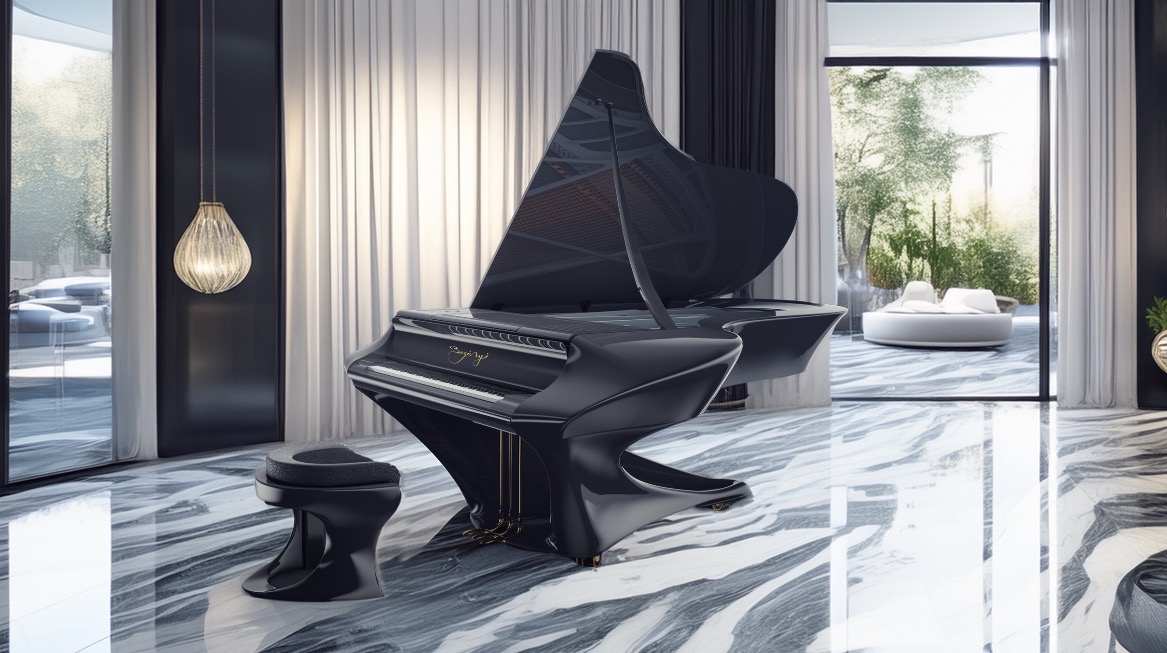
Contemporary piano makers and designers are once again experimenting with shape, color, materials and decoration.
Modern grands can have radically redesigned legs and pedal lyres, unusual veneers, brilliant colors, sculptural cases and completely avant-garde silhouettes.
FAZIOLI, for example, explicitly offers custom instruments in classic, modern and avant-garde shapes, with special woods, colors, mother-of-pearl, metals, semiprecious stones and hand-painted surfaces.
In other words, after more than a century dominated by the elegant black concert grand…
the piano is becoming fashionable again.
And perhaps we have come full circle.
In the 18th century, a piano was simultaneously a musical instrument and an important piece of interior design.
In the 21st century, it can once again be both —
an extraordinary musical instrument and a work of art.
The fascinating difference is that today technology allows designers to reinvent almost everything we see while preserving the sophisticated acoustic engineering hidden inside.
Three centuries later, the piano is still evolving.
And I absolutely love seeing where designers take it next. 🎹✨