Today, some of the most popular searches online include phrases like “best piano teacher in LA,” “piano lessons in LA,” “music lessons in LA,” “classical piano lessons,” and “piano classes in LA.” Parents are not simply searching for an extracurricular activity — they are searching for discipline, intellectual growth, artistic refinement, confidence, and high-level cultural education for their children. Interestingly, this connection between piano study, education, sophistication, and social status is not new at all. In fact, the idea that learning the piano reflects refinement, intelligence, and belonging to an educated social class dates back centuries, especially to the 18th and 19th centuries, when piano playing became one of the defining accomplishments of educated women in Europe.
The history of the piano is deeply connected to culture, literature, women’s education, and the development of classical music traditions that still influence piano lessons today.
The Piano Was Considered a “Necessary Accomplishment”
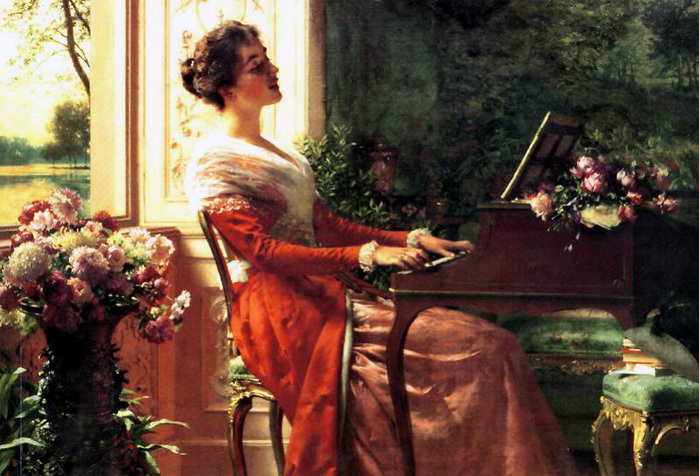
In the 18th and early 19th centuries, wealthy and upper-middle-class families expected daughters to study music as part of their education. A young woman who could play piano beautifully was considered cultured, elegant, and intellectually refined.
At social gatherings, women often performed for guests in salons and drawing rooms. Playing works by composers like Wolfgang Amadeus Mozart or Ludwig van Beethoven demonstrated not only musical skill but also discipline and education.
Unlike many professions that were closed to women at the time, music was considered an “acceptable” artistic pursuit — as long as it remained within the home.
For a fascinating overview of how keyboard instruments evolved during this era, the Metropolitan Museum of Art Piano History provides excellent historical context.
Why the Piano Became So Popular
The piano was uniquely suited to domestic life. It could accompany singers, perform orchestral reductions, and provide entertainment for entire evenings.
But there was also something visually symbolic about piano playing. Graceful posture, delicate hand movements, and emotional expression aligned perfectly with 18th-century ideals of femininity and refinement.
As piano manufacturing improved, instruments became more available in private homes across Europe. Families often viewed owning a piano as a sign of sophistication and education.
This cultural tradition eventually spread worldwide and helped establish the piano as one of the most respected instruments in music education — a reputation it still holds today in classical music conservatories and piano schools around the world.
The Piano as a Symbol of Status and Education
Even today, musical education — especially the ability to play the piano — continues to carry a strong cultural association with education, refinement, discipline, and social status. While society has changed dramatically since the 18th century, the piano still occupies a unique place in the public imagination.
Historically, owning a piano was expensive. It required not only financial resources to purchase the instrument itself, but also access to private teachers, sheet music, leisure time for practice, and a home environment where artistic education was valued. For this reason, piano study often became associated with educated and affluent families.
In many ways, this perception continues into modern life. Parents who invest in high-level classical music education, piano lessons, and serious artistic training are often seen as prioritizing intellectual and cultural development alongside academics. The ability to play piano fluently still carries an image of sophistication, self-discipline, and belonging to a highly educated cultural environment.
This does not mean that music belongs only to elite circles — far from it. Today, piano education is more accessible than ever. But historically, and even psychologically today, the piano remains connected to ideas of refinement, ambition, opportunity, and cultural capital in a way few other instruments do.
Music and Marriage Prospects
In many cases, piano study was closely connected to marriage expectations.
A talented pianist was often viewed as more desirable socially because music reflected patience, discipline, emotional sensitivity, and cultural education. Literature from the period — especially novels by Jane Austen — frequently portrays piano performance as an important social skill.
Ironically, women were encouraged to perform music privately but often discouraged from pursuing professional careers as composers or concert artists.
Still, many extraordinary female musicians emerged despite these limitations. One famous example is Maria Anna Mozart, whose talent rivaled her brother’s in childhood but whose musical career was restricted by social expectations of the time.
You can explore more forgotten women composers through Classic FM’s Women Composers Collection.
What Modern Science Says About Music Education
Interestingly, many benefits associated with piano study today mirror what society intuitively valued centuries ago.
Modern neuroscience shows that learning piano strengthens:
- memory
- language processing
- coordination
- emotional regulation
- concentration
- creative thinking
Research from Harvard Medical School on Music and the Brain explains how deeply music training affects brain development and cognitive flexibility.
This is one reason why parents today continue searching for high-quality piano classes in LA, classical music education, and experienced piano teachers who can combine technique with artistic development.
From Social Obligation to Personal Expression
The meaning of piano study has changed dramatically over the centuries.
In the 18th century, many girls learned piano because society expected them to. Today, students learn for completely different reasons: creativity, emotional expression, artistic passion, intellectual growth, and personal fulfillment.
Yet the cultural legacy remains. The piano still carries a unique aura of sophistication, emotional depth, and intellectual beauty unlike almost any other instrument.
And perhaps that is why, even in the digital age, classical piano music continues to inspire audiences around the world.