
As a concert pianist and educator offering piano lessons in Los Angeles, I have always been fascinated by the relationship between anatomy and piano technique. For students seeking the best piano teacher in Los Angeles, private piano lessons in West LA, or classical music classes, a groundbreaking study from Stanford University raises an extraordinary question: What if the greatest obstacle to playing certain piano masterpieces is not a lack of talent or technique, but the size of the keyboard itself?
The Discovery That Started with a Pair of Hands
For years, Elizabeth Schumann, a concert pianist and professor at Stanford University, believed she had relatively large hands. After all, she could reach a tenth on the piano.
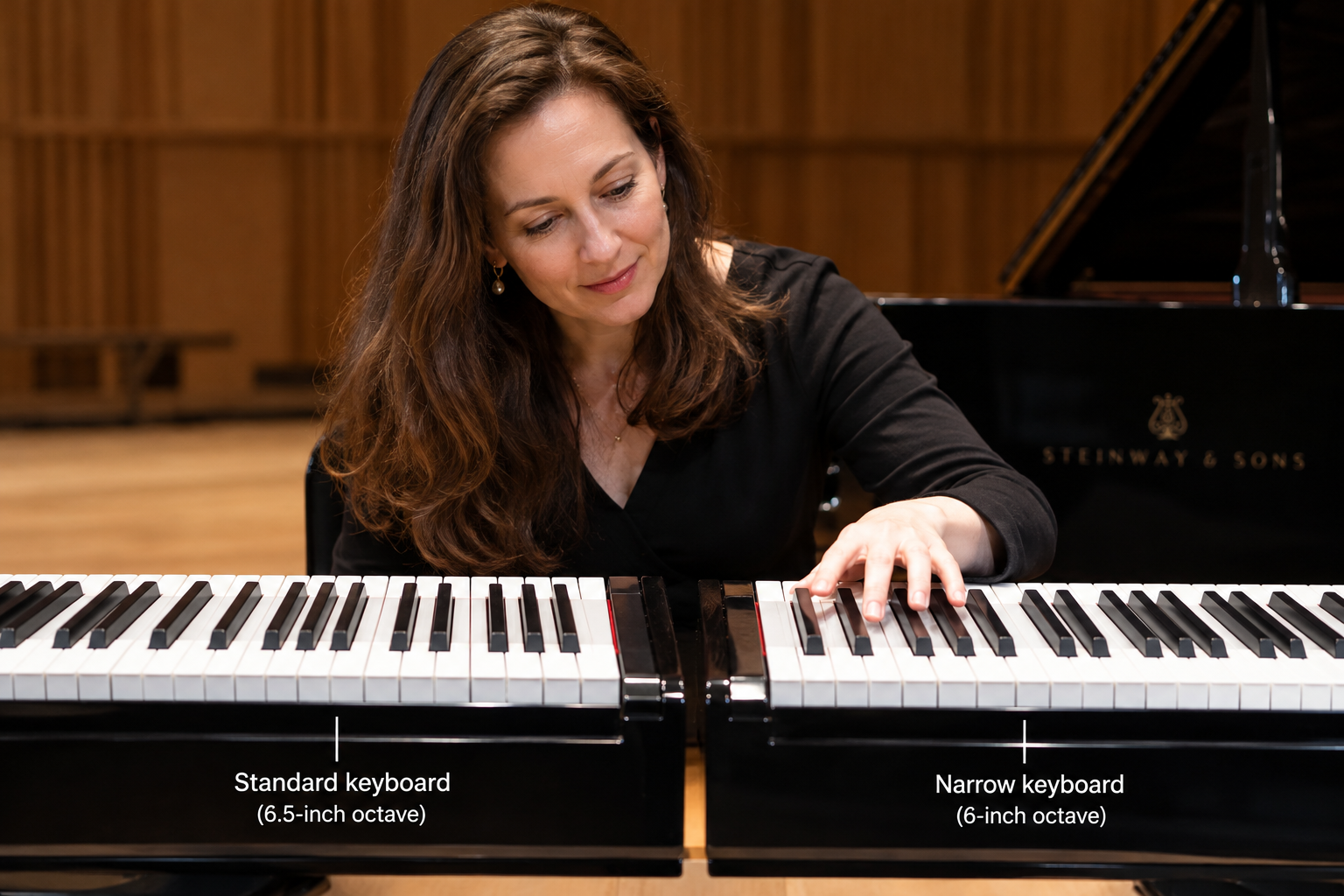
Then she tried a keyboard with narrower keys.
The experience was astonishing. Passages that had always demanded considerable stretching suddenly felt natural and comfortable. Schumann compared the revelation to discovering that she had been wearing the wrong shoe size her entire life.
She began questioning why pianists were expected to adapt to a single keyboard size when human hands vary so dramatically.
The statistics were startling: research involving 473 adult pianists found that only 13% of women, compared with 76% of men, had hands large enough to comfortably manage rapid, repeated octaves on a standard keyboard.
Turning a Personal Discovery into Scientific Research
Rather than simply advocating for smaller keyboards, Schumann decided to investigate their benefits scientifically.
Supported by Stanford’s Wu Tsai Human Performance Alliance, she began studying how pianists perform on conventional keyboards versus narrower alternatives.
Her research examined speed, accuracy, force, and volume. The early findings showed that pianists with smaller hands could produce greater force and volume on narrower keyboards.
Working with computer scientist Karen Liu, Schumann also explored how artificial intelligence and three-dimensional motion analysis could reveal the mechanics of piano playing.
And the scientific evidence continues to grow. A 2026 study in Applied Ergonomics reported reduced forearm muscle activation on narrower keyboards, while additional research on muscular fatigue investigated their potential ergonomic benefits.
Rachmaninoff, Schumann, and a New World of Possibilities
The artistic implications are extraordinary.
One of Elizabeth Schumann’s students performed Rachmaninoff’s Second Piano Concerto on a narrower keyboard — a masterpiece she reportedly would never have attempted on a conventional instrument.
Imagine how many musicians with smaller hands could finally approach the enormous chords of Rachmaninoff, the formidable stretches of Robert Schumann’s Toccata in C major, Op. 7, and countless other masterpieces previously considered physically inaccessible.
These keyboards are not simplified instruments. They preserve all 88 keys and the complete musical range, while reducing the width of the keyboard to better accommodate different hand sizes.
Although narrower keyboards were developed decades ago, Elizabeth Schumann’s research at Stanford is helping provide the scientific evidence needed to challenge the traditional one-size-fits-all approach.
As a pianist trained in the Russian classical tradition, I find this development particularly exciting. Musical greatness should be determined by artistry, imagination, intelligence, and expression — not by the distance between a pianist’s thumb and fifth finger.
For centuries, pianists have adapted themselves to the piano. Perhaps it is finally time for the piano to adapt to the pianist.
Dr. Natalia Kartashova, Ph.D., DMA
Concert Pianist & Piano Educator
Russian Academy of Music — Los Angeles, California