
For families who value music, believe in developing a child’s talent, and explore piano lessons in Los Angeles, music classes in Los Angeles, or the best piano teacher in LA, musical education often begins with curiosity. And few instruments inspire more curiosity than this extraordinary creation: the 19th-century harp piano.
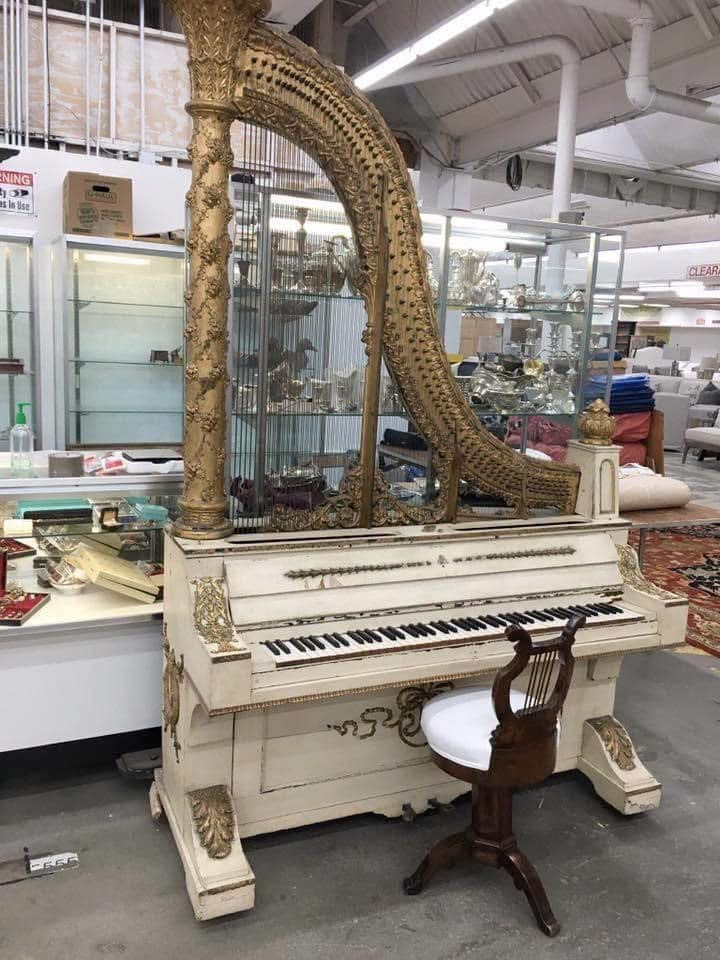
At first glance, it appears to be half piano, half harp. But the exposed strings are not simply decorative.
The harp piano, or upright harp piano, emerged during a fascinating period of experimentation in the 19th century, before the modern upright piano had acquired the form we recognize today. Instead of hiding the strings and much of the frame inside a conventional cabinet, makers allowed them to rise dramatically above the keyboard — giving the instrument its unmistakable harp-like silhouette.
One surviving American example at the Smithsonian National Museum of American History dates from approximately 1850–1875. Its maker remains unknown. It has felt hammers, two pedals, exposed strings and an elaborate carved and gilded case.
Explore the original instrument at the Smithsonian →
And here is the wonderful surprise: it still works as a piano. Pressing a key activates a piano action and a hammer strikes the corresponding string. The player does not pluck those beautiful exposed strings as on a harp.
In 1857, Kuhn & Ridgeway of Baltimore produced similar harp pianos with standard upright action, felt hammers, straight stringing and two pedals.
See the 1857 Kuhn & Ridgeway Harp Piano at the Smithsonian →
An even more extraordinary relative survives at The Metropolitan Museum of Art: the Euphonicon of 1843, based on a design patented by John Stewart in 1841. Instead of a conventional soundboard, it used three separate hollow sound chambers. Even more fascinating, its highest 23 notes had no dampers, allowing them to continue vibrating — and even to resonate sympathetically while other notes were played.
Discover the 1843 Euphonicon at The Metropolitan Museum of Art →
Imagine hearing that resonance in person.
For a pianist, instruments like this are more than beautiful historical curiosities. They remind us that the piano itself was once an experiment — continually redesigned by people searching for greater resonance, expression, beauty and color.
And perhaps that is one of the most valuable things we can give young musicians through piano lessons and classical music education in Los Angeles: not simply the ability to play the notes, but the curiosity to ask why an instrument sounds the way it does — and how a pianist can transform that sound into music.