

From Gilded Salons to Spaceships: The Extraordinary Evolution of the Grand Piano
At Russian Academy of Music, where students discover the artistry of piano playing through the Russian piano tradition, we believe that a piano is far more than an instrument — it is a world of imagination waiting to be explored. Whether you’re searching for the best piano teacher in Los Angeles, private piano lessons in LA, piano classes for kids and adults, beginner piano lessons, advanced piano instruction, professional piano training, or an exceptional Russian piano teacher in West Los Angeles, allow us to take you on a journey into one of music’s most astonishing design revolutions.
Imagine entering a magnificent concert hall.
The lights dim. The audience falls silent. At the center of the stage stands something extraordinary — a gleaming, sculptural object with sweeping curves, impossible angles, and a silhouette that seems to defy gravity.
Is it a spaceship? A piece of futuristic architecture? A sculpture destined for a museum of modern art?
Then a pianist approaches, sits down, and places their hands on the keyboard.
And suddenly, the room fills with Chopin.
Welcome to the extraordinary world of the futuristic grand piano.
Once Upon a Time, a Piano Was a Palace
Long before anyone dreamed of spaceships, grand pianos were already objects of breathtaking luxury.
In the magnificent salons of 19th-century Europe, instruments were adorned with precious woods, elaborate carvings, gilded ornaments, and intricate paintings. They were not merely played — they were admired, displayed, and treasured as symbols of wealth and artistic sophistication.
Around 1902, the French Art Nouveau master Émile Gallé created an extraordinary decorated piano, transforming its wooden surfaces into a poetic celebration of nature.
Flowers seemed to bloom across its body. Delicate botanical patterns flowed through the wood. The instrument became a marriage of craftsmanship, imagination, and music.
But although its decoration was revolutionary, the familiar silhouette of the grand piano remained.
It would take another generation of dreamers to ask a far more daring question:
What if we changed the shape of the piano itself?
The Day a Spaceship Landed in the Concert Hall
Imagine a designer looking at the elegant curves of a traditional grand piano and deciding that nearly everything about its appearance could be reinvented.
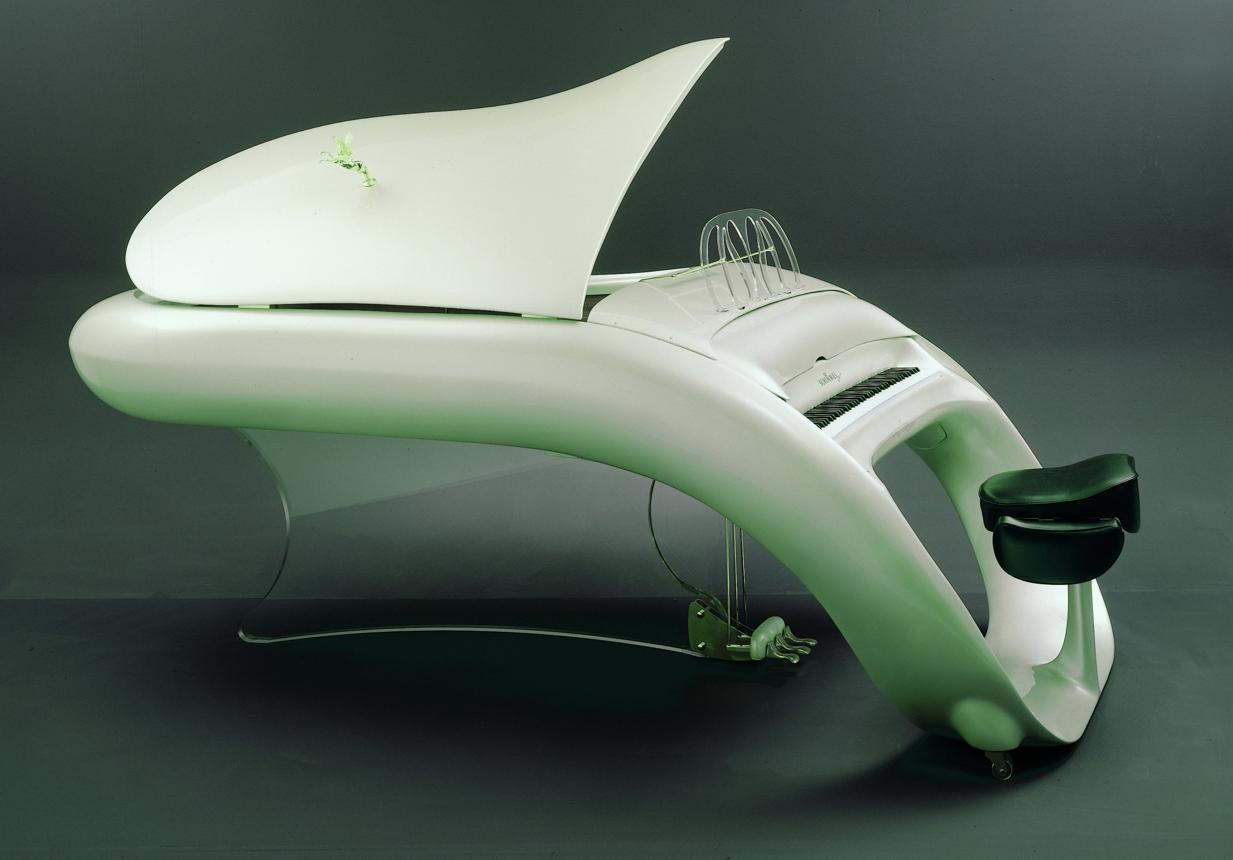
That spirit gave us the astonishing Schimmel Pegasus, developed in collaboration with the legendary industrial designer Luigi Colani.
With its gleaming white body, aerodynamic curves, and sculptural contours, the Pegasus seems less like a musical instrument and more like a spacecraft that has quietly landed in an elegant penthouse.
You almost expect it to levitate.
And yet, beneath its otherworldly exterior lies a genuine acoustic grand piano, with the familiar complexity of hammers, strings, and resonating wood.
The Pegasus became a striking example of what happens when the imagination of an industrial designer meets the centuries-old traditions of piano manufacturing.
Today, it remains an unusual collector’s instrument, with prices dependent on availability and condition.
The Pianist Who Dreamed of Reinventing the Piano
Some revolutions begin in a designer’s studio.
Others begin in the mind of a musician.
Hungarian concert pianist Gergely Bogányi imagined a grand piano that would not simply look different, but would challenge certain assumptions about how an acoustic instrument should be constructed.
The result was the remarkable Bogányi Piano, unveiled in 2015.
Its sweeping black body resembles a magnificent bird preparing to take flight. Its unusual supporting structure creates the impression that the instrument is floating above the floor.
But this was not merely an exercise in visual extravagance.
The Bogányi project explored alternative materials and construction techniques in pursuit of a distinctive acoustic character.
It was a bold reminder that even after centuries of refinement, the grand piano might still have unexplored possibilities.
Such instruments belong to the world of bespoke luxury craftsmanship, where prices are generally supplied individually.
A Piano Made of Crystal and Light
Now imagine a grand piano that seems to have been carved from ice.
Its transparent body catches the light. The strings shimmer inside. Every hammer, every mechanical movement, every intricate detail becomes part of the visual performance.
This is the enchanting world of the Kawai Crystal Grand.
Unlike the familiar black concert grand, whose mysterious interior remains largely concealed, the Crystal Grand reveals its extraordinary anatomy.
It is as though someone has removed the walls of a magnificent building and invited us to watch its machinery come alive.
The effect is simultaneously delicate, futuristic, and theatrical.
And when the pianist begins to play, the transparent sculpture becomes a living musical instrument.
These specialty models occupy the luxury end of the piano market, with pricing varying by version and availability.
When Italian Elegance Becomes Architecture
Not every futuristic piano needs to resemble a spaceship.
Sometimes, the most extraordinary transformation comes from a subtle interplay of proportion, line, material, and light.
The Italian manufacturer Fazioli has long been associated with meticulous craftsmanship and exceptional concert instruments.
Its special designer models demonstrate how a grand piano can become a striking architectural statement without abandoning its musical identity.
Here, the piano is not merely furniture placed inside a beautiful room.
It becomes the room’s visual heartbeat.
An object around which the entire interior seems to revolve.
When a Piano Almost Disappears
Perhaps the most intriguing direction in contemporary piano design is the idea of making an instrument almost unrecognizable.
Imagine a sweeping architectural structure, a sculptural island, or an elegant futuristic installation occupying the center of a room.
Only when you move closer do you discover the keyboard.
What appeared to be an abstract work of art is, in fact, a musical instrument.
This fascination with fluid, almost impossible forms recalls the architectural language of Zaha Hadid, whose extraordinary buildings often seem to have been shaped by wind, water, and movement rather than conventional geometry.
It is a world in which architecture, furniture, sculpture, and musical instruments begin to blur into one another.
And perhaps that is the most exciting idea of all.
But What Happens When the Music Begins?
As a concert pianist, I find myself returning to one essential question.
A piano can be breathtakingly beautiful. It can resemble a sculpture, a spacecraft, or a magnificent architectural fantasy.
But can it sing?
Can it produce the delicate, almost whispered tenderness of a Chopin nocturne?
Can it sustain the immense emotional architecture of Rachmaninoff?
Can it respond to the subtlest movement of a pianist’s fingers, transforming an almost imperceptible touch into an unforgettable musical phrase?
Because ultimately, the greatest luxury of a grand piano is not its appearance.
It is its voice.
And perhaps the most extraordinary achievement of modern piano design is not that we have learned to make instruments look like objects from the future.
It is that, beneath those astonishing shapes, we are still searching for the same timeless miracle:
A beautiful sound capable of touching the human soul.
And now, imagine one of these extraordinary instruments standing in your own living room.

